Did You Know Your Oxygen Costs? Discover How Much You Could Save!
Discover how much you could save on oxygen costs with our insightful guide. Uncover potential…

This issue will continue the discussion of the chemical absorption of carbon dioxide from the rebreathing system. Removal is by the chemical process discussed in the previous issue. There are, however, conditions that may cause the absorption to be less efficient than desired.
The canister for the absorbent granules contains more than just the granules. There are four spaces or volumes present in the canister.
The void space is the space between the granules. This space is directly proportional to the size of the granules—large granules have more space between them, while small granules fit close together, resulting in less void space. The tighter the granules are packed, the less void space is present, and the higher the resistance to flow. The void space of soda lime is typically 40-47% of its volume.
The pore space exists within the pores of the granules. For fresh absorbent, the pore volume is about 8% of the total volume. As absorption proceeds, the pore space decreases.
Let’s assume a canister that has a total volume of 4000 ml and is filled with sodasorb:
Improper storage and handling of absorbent can decrease efficiency. Temperatures below freezing will cause the moisture in the granules to expand and create fragmentation. If bulk containers are used, they should be resealed once they have been opened. Granules should be handled gently to prevent fragmentation, which in turn creates dust. This dust can be irritating to the eyes and airways of the operator.
Filling the canister should be done gently, and packing the granules by tapping the side of the canister should not be overdone. The tighter the granules are packed, the higher the resistance to flow through the canister.
Do Not Overfill: Leave 1/2 to 3/4 inch of space at the top of the canister. This helps prevent spillage when the canister is secured to the breathing system.
During the evaluation of a rebreathing system, the granules should be tested for freshness. Fresh granules of soda sorb are soft enough to be crushed between the thumb and forefinger.
Expended Granules: Granules that are expended are too hard to crush. As mentioned in Part I, the granules become calcium carbonate, which is a form of limestone when they are used up.
The next issue will discuss canister designs and the flow of gas through the canister.
1. Dorsch JA, Dorsch SE. Understanding Anesthesia Equipment, 4th Edition: Williams and Wilkins, 1999, page 236.
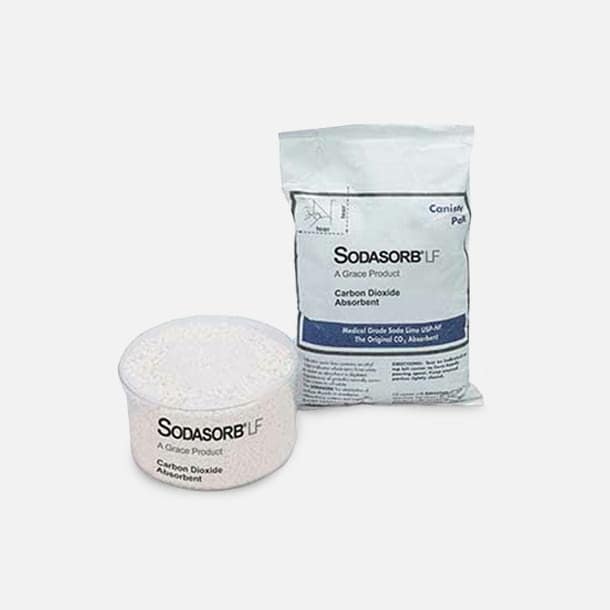
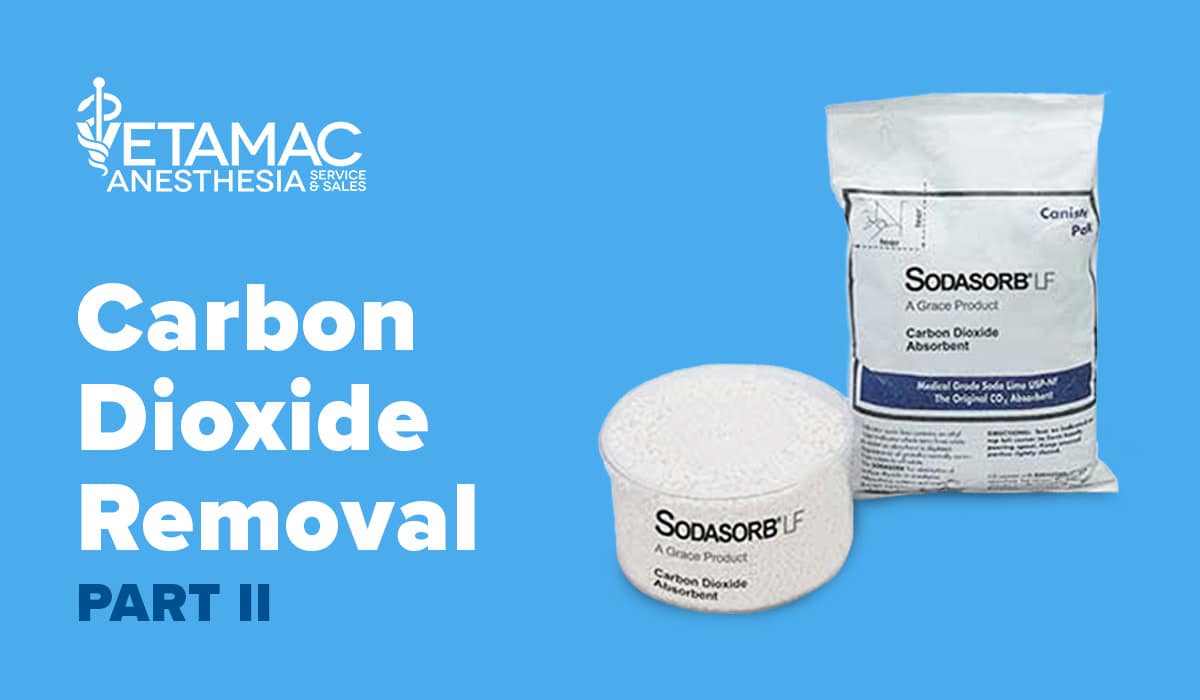
A new product called Sodasorb LF is now available. It is made for low flow procedures. The other good benefit of this product is that once it turns violet, it will not return to it’s original color. This product should be available through your distributor.


Veterinary Specialist Articles