Vol. XIV: Anesthesia Machine Maintenance After a Procedure
Learn essential tips for anesthesia machine maintenance after procedures to enhance safety, equipment longevity, and…

In the previous issue of Vapors, two of the characteristics of the anesthetic machine were discussed—volume and flow. The relationship between these characteristics determines the rate of change of anesthetic concentration in the system when vaporizer settings are adjusted.
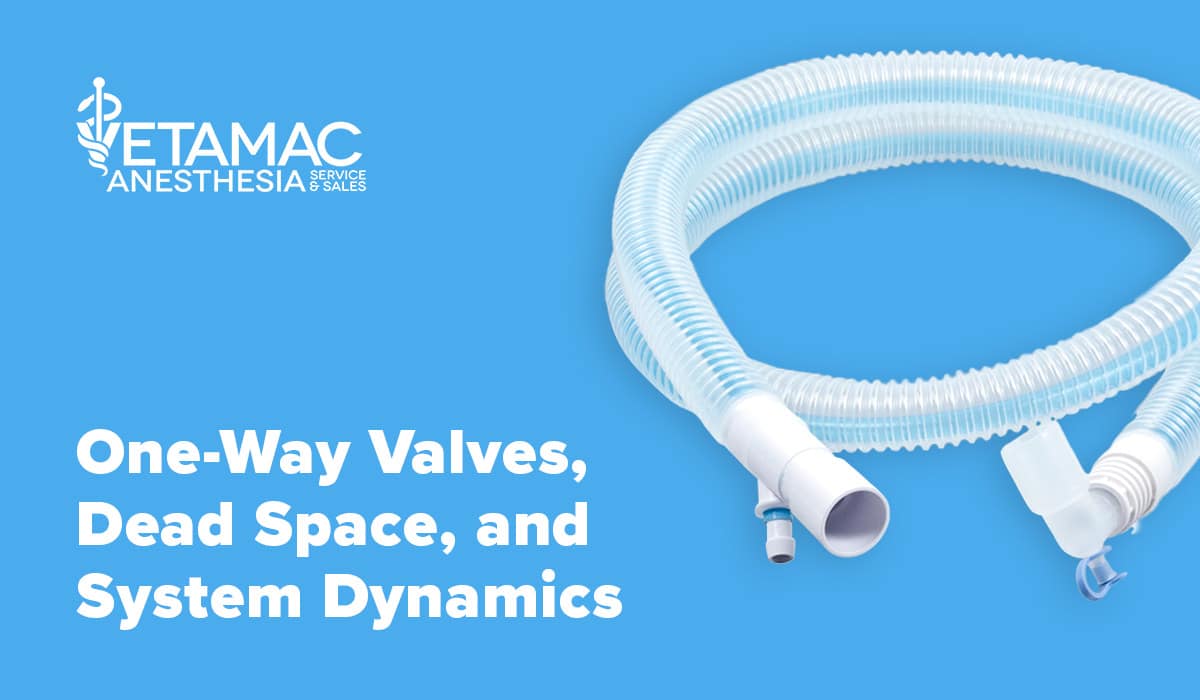
A third characteristic is one-way valve configuration and function. If the one-way valves do not function properly, this creates dead space, preventing fresh gas from reaching the patient and inhibiting carbon dioxide (CO2) removal. If sufficient fresh gas does not reach the patient, this can result in light anesthesia. Similarly, if CO2 is not being eliminated, it will cause an increase in breathing rate due to elevated carbon dioxide levels in the blood.
The final characteristic is the amount of intentional mechanical dead space. This has the same effect as improperly functioning one-way valves and is caused by monitoring devices attached to the endotracheal tube or excess length of the tube outside the mouth. Minimizing this dead space as much as possible is crucial for maintaining proper gas exchange.
The second system to consider is the non-rebreathing system. In this system, no rebreathing of expired gases occurs, and there is no resistance to breathing since there are no one-way valves. If the fresh gas flow is high enough, it can flush all of the expired gas away before the next inspiration, preventing mixing of fresh and expired gases. This allows changes in inspired concentration to take place immediately, offering better control but at a higher cost compared to the rebreathing system.
By understanding the basics of the machine and how it affects DUDE (Dynamic Understanding of Dose Equivalence), the anesthetist is better equipped to diagnose potential issues with the system. It’s important to remember that there is no inherently “safe” inhalation agent or anesthetic procedure—only safe anesthetists who fully understand the equipment and its function.
If the canister is filled too full, granules may become lodged between the canister edge and the seals. This creates the potential for leaks. This can be prevented by filling the canister to approximately 3/4 of an inch from the top.
Changing the CO2 absorbent. As the absorbent is exhausted and is in the machine for long periods of time, it absorbs moisture and this moisture will collect in the machine. This causes the seals and other parts of the machine to deteriorate.
No. These fittings are a compression style fitting and the tighter the nut, the tighter the seal between the hose fitting and machine fitting. Many DISS fittings have an internal O-ring that makes the seal even better.
Stefanie Skiles. Stefanie graduated from Purdue University in 2005 with a degree in Animal Agribusiness and a minor in Ag Economics. Stefanie joined Vetamac in March 2006 working as an in-house lab technician in the vaporizer lab. She currently serves as a field service technician in Indiana. Stefanie resides in the Rossville, Indiana area with her husband, Chad, one dog, and two cats. She enjoys working with her husband on their hog farm which is jointly owned with his brothers. Stefanie also enjoys working for Skiles Construction, the construction company owned by her and her husband. Her hobbies include reading, cooking, and outside activities.

Veterinary Specialist Articles