Did You Know Your Oxygen Costs? Discover How Much You Could Save!
Discover how much you could save on oxygen costs with our insightful guide. Uncover potential…


Questions frequently arise about what size rebreathing bag or size and length of breathing circuit to choose. This issue of Vapors will discuss three questions related to tubes and bags.
The first question is asked most frequently. “What size bag do I use” or “Should I use an adult or pediatric breathing circuit”? Let’s ask some additional questions regarding this issue.
Can the patient be too big for a small bag and pediatric breathing circuit?
The obvious answer is yes, but why? If the bag is too small, the patient may exhaust the volume of gas that is in the bag especially if the bag does not remain full. If the breathing circuit is too small, increased resistance becomes the issue. This makes the work of breathing more difficult and less efficient.
Can the circuit and bag be too big for the patient?
In theory, the answer is no. But practically, the issue of time constants needs to be considered. If the circuit and bag are too big, the volume of the system is increased and the time required to change the inspired concentration of anesthetic is increased. With each increase in bag size, the volume of the system is increased by 1 liter. If the breathing circuit diameter is increased by one half (using an adult “Y” instead of a pediatric “Y”), the volume of the circuit is more than doubled. For more information on time constants, see Vetamac Vapors, Volume II Issue 3.
| Patient Weight | Bag Size |
|---|---|
| – 15# | 0.5 – 1 L |
| 15# – 44# | 2 L |
| 44# – 75# | 3 L |
| 75# – 135# | 4 L |
| + 135# | 5 L |
| Patient Weight | Circuit Size |
|---|---|
| 15# – 26# | Pediatric |
| + 26# | Adult |
Another question regarding this issue is the length of the breathing circuit. Certain situations require the use of circuits 5 or 6 feet long. In this case, both resistance and the time constant are affected.
As the length of the circuit increases, the volume increases proportionally. A 6-foot circuit will have 2X the volume of a 3-foot circuit. The resistance also increases as the length of the circuit increases, but it is exponential, not linear. For this reason, circuits that are longer than necessary should be avoided.
The second question for discussion is the composition of the circuits and bags. Circuits are usually made of appropriate plastic materials or rubber. Either one is acceptable, but most people prefer the plastic circuits because they are lighter in weight. The rubber circuits usually last longer. The type of circuit used is at the discretion of the user.
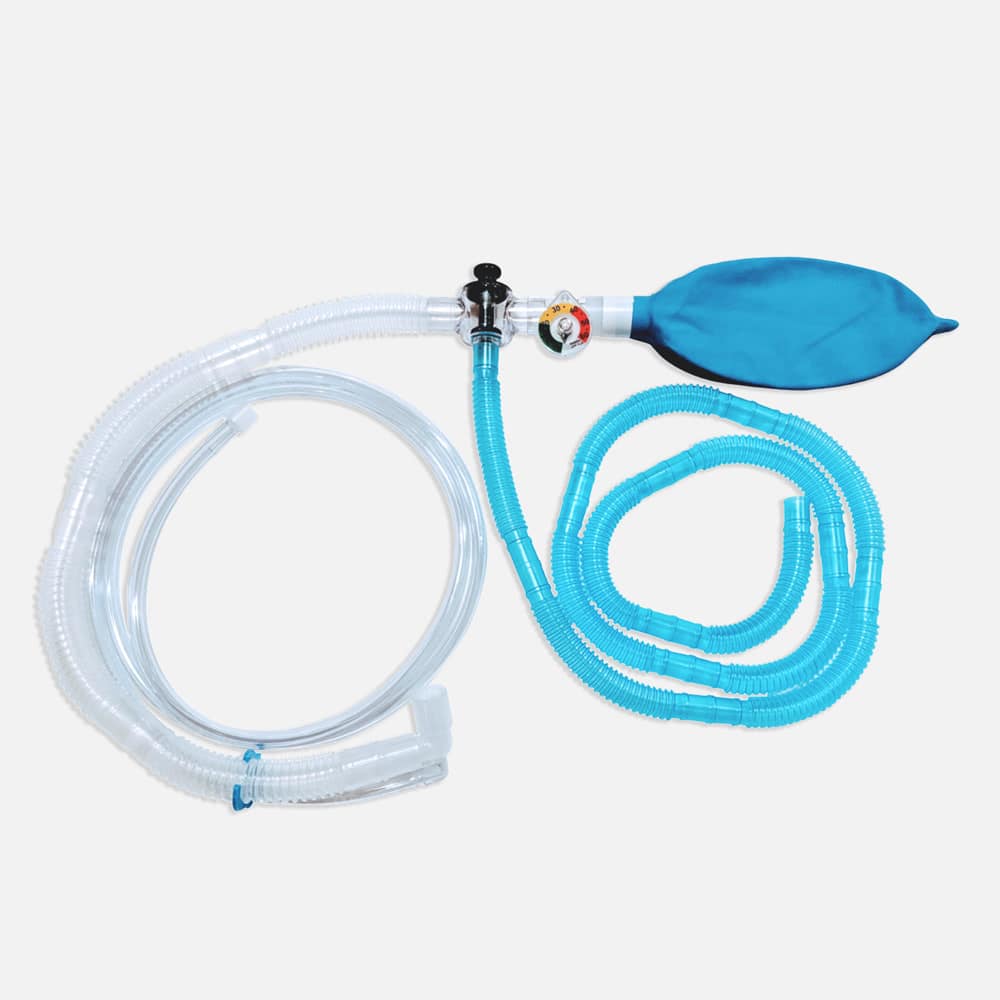
Bags are typically non-latex or latex rubber, which are usually green or blue. Black rubber bags are also widely used. Both styles of bags are susceptible to dry rot around the neck. This can be prevented by storing the bags in a cool, dry, and dark location. Strong light, either fluorescent or sunlight, can cause deterioration in bags.
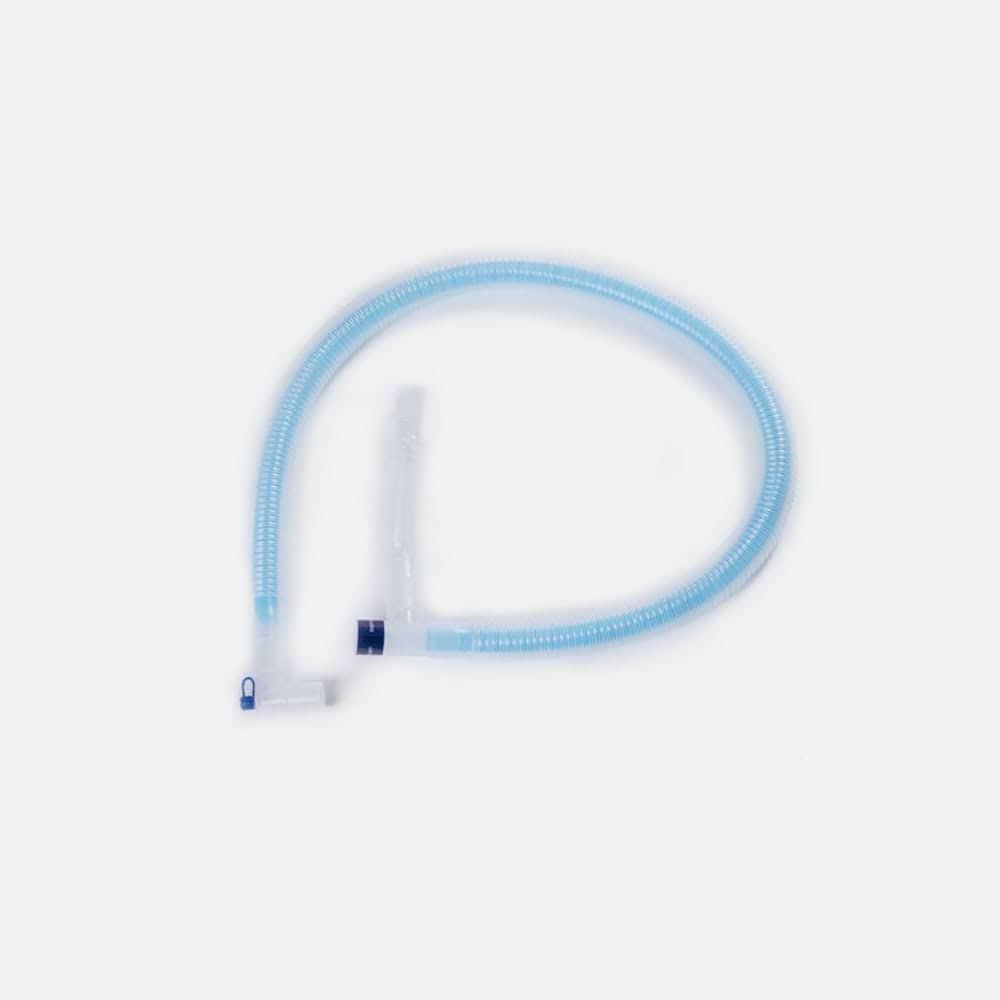
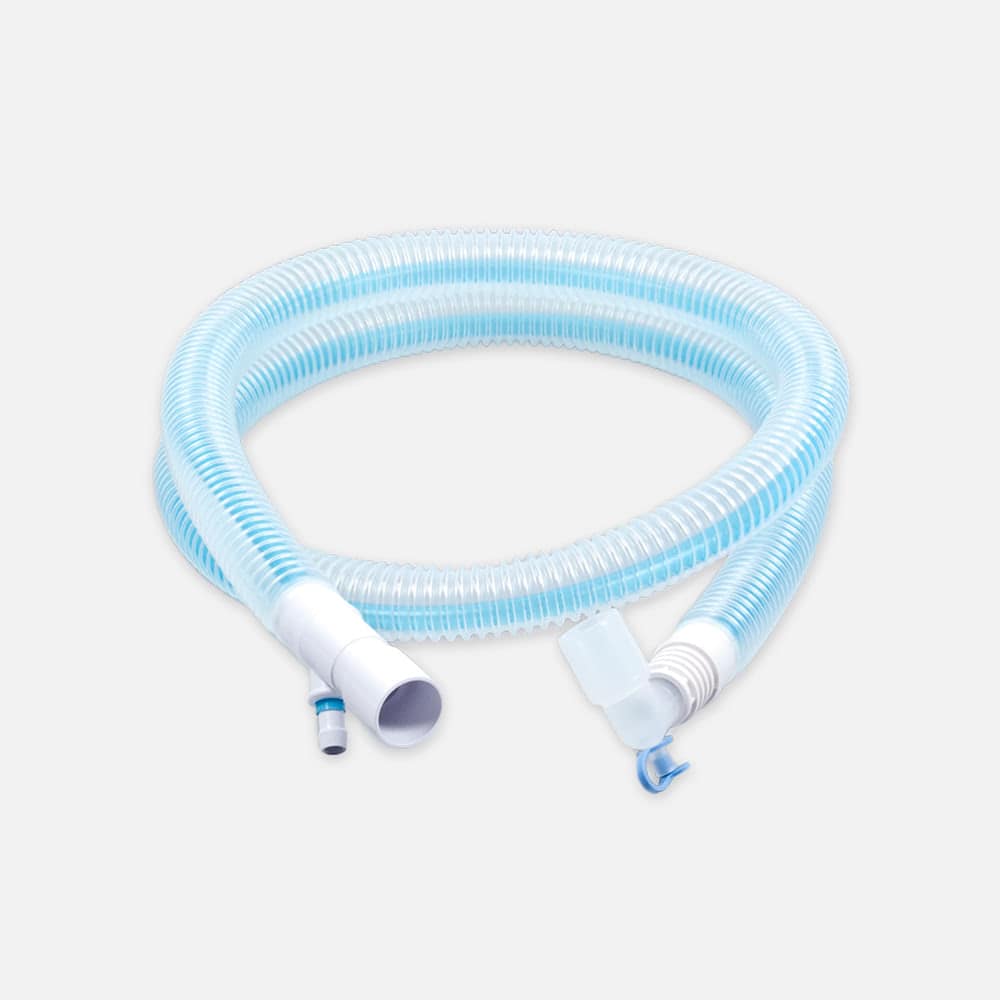
The final question regards the configuration of the breathing circuit: coaxial (Universal F) or conventional “Y”. Functionally, there is little or no difference between them, except there will be slightly increased resistance in the coaxial circuit.
The advantages of the coaxial circuit are that there is only one tube going to the patient, and the inspired gas is warmed by the expired gas that surrounds the inspiratory tube. The discretion and preference of the user usually determine which configuration is used.
Issues related to tubes and bags are important and need to be given proper consideration to maximize patient safety.



Veterinary Specialist Articles