Vol. II: The Anesthetic Machine as an Intermittent Dosing Device
Learn how the anesthetic machine influences pharmacokinetics, drug uptake, distribution, and elimination for optimal anesthesia…

This discussion continues with the Minimum Alveolar Concentration (MAC), the second of three characteristics of inhalant agents that affect DUDE.
MAC is an attempt to describe a dose for inhalation agents. It represents the alveolar concentration at which 50% of animals will not respond to a painful stimulus. However, the desired response in clinical anesthesia is 0%, meaning that the alveolar concentration required to achieve a surgical plane of anesthesia will be higher than MAC. In fact, it will typically be about 1.5 times MAC.
The induction time, or the time required to reach this concentration, is influenced not only by the Blood/Gas (B/G) coefficient but also by the multiple of MAC that is administered during induction. For example, the MAC for isoflurane is 1.3%. If the vaporizer is set to 5% during induction, approximately 3.8 times MAC is being administered. Similarly, the MAC for sevoflurane is 2.25%, and setting the vaporizer to 8% delivers about 3.5 times MAC. These multiples of MAC during induction help reduce the induction time.
Regardless of the B/G coefficient, induction time is prolonged if the concentration administered is only that required for maintenance. This is why vaporizers are designed to administer concentrations higher than those needed for maintenance.
The third physical characteristic to consider is the vapor pressure (VP) of the anesthetic agent. While VP does not directly affect DUDE, it does dictate the specifications of the vaporizer for that particular agent.
Vapor pressure describes the liquid agent’s ability to evaporate (vaporize). The higher the VP, the more easily the agent vaporizes, and vice versa. The VP determines the partial pressure (or concentration) of anesthetic in the sump of the vaporizer. For example, the concentration of isoflurane in the sump is 32%, and for sevoflurane, it is 21%. This is why vaporizers must be very precise in metering the oxygen (O₂) through the sump to deliver the dialed concentration. Additionally, this is the reason that vaporizers are agent-specific.
The characteristics of the anesthetic machine also affect DUDE. One way to conceptualize the machine is as an intermittent dosing device. The agent is delivered or eliminated only when the patient breathes; the rest of the time, the machine acts as a reservoir for oxygen and anesthetic.
The first system to consider is the rebreathing circuit, where the first two critical characteristics are volume and flow. The rebreathing circuit is a dynamic system, with constant mixing of fresh and expired gases. Since gases are continuously mixed, the size of the rebreathing system and the rate of fresh gas flow can significantly influence the rate of change in concentration within the system.
The time required for the concentration to rise or fall to the desired level may range from 3 to 30 minutes, depending on the volume and flow (see chart below).
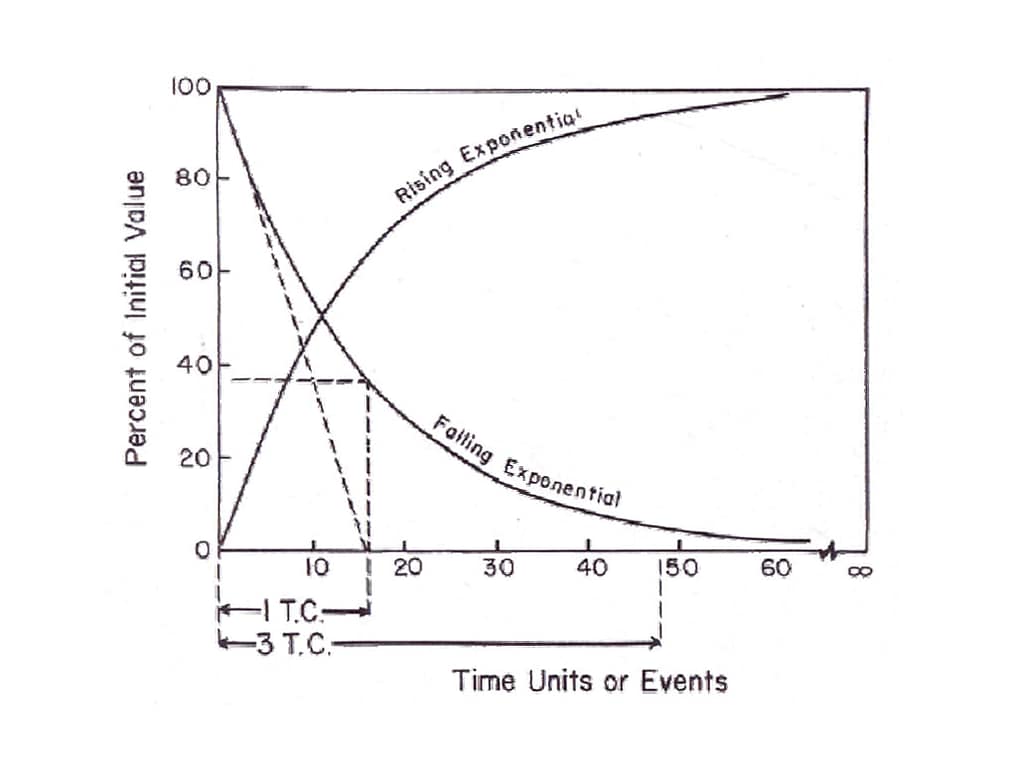
The rise or fall in concentration is governed by the time constant, which is calculated by dividing the volume of the system by the flow rate into the system. For example, if the system holds 4 liters (a typical estimate for many veterinary anesthetic machines) and the flow rate is 1 liter per minute, the time constant would be 4 minutes.
For a change in concentration, the following applies:
Therefore, if the vaporizer is turned from 2% to 3%, it will take 4 minutes for the concentration to increase by about 0.6%. To achieve a full 1% rise in concentration, it would take approximately 12 minutes (3 time constants).
Because the rebreathing circuit is a dynamic system, the inspired concentration of anesthetic will be lower than the concentration dialed on the vaporizer during both induction and maintenance periods. During induction, the difference is typically greater, and during recovery, the difference is reversed – the inspired concentration will be higher than the concentration set on the vaporizer.
In this article, we’ve examined the key factors influencing inhalant anesthesia, including Minimum Alveolar Concentration (MAC), vapor pressure (VP), and the dynamics of the rebreathing circuit. These elements highlight how the anesthetic machine functions as an intermittent dosing device, delivering precise doses based on the patient’s breathing.
Understanding these principles is crucial for optimizing anesthesia and ensuring patient safety. Stay tuned for the next issue of Vapors for a deeper dive into the anesthetic machine’s role in precise dosing.
The next issue of Vapors will complete the discussion of the anesthetic machine as an intermittent dosing device.
Veterinary Specialist Articles