Veterinary Specialist Articles
TPLO Surgery for Dogs: Success Rates and Alternative Options
Explore TPLO surgery for CCL rupture in dogs: indications, surgical techniques, success rates, and alternatives…


Before discussing the measurement of blood pressure, some of the terms associated with blood pressure need to be defined:
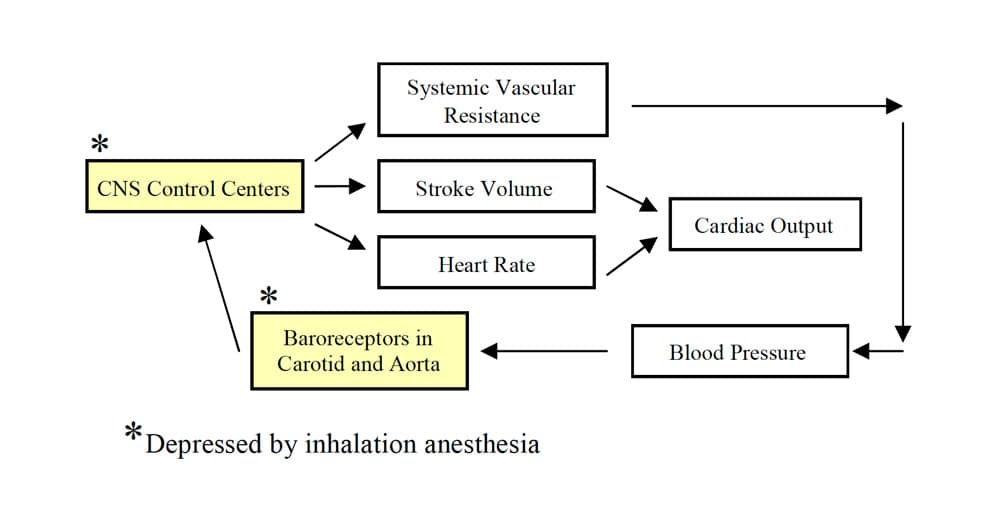
The diagram below is a basic representation of how blood flow is controlled to the peripheral tissues. Stroke volume and heart rate determine the cardiac output, while cardiac output and peripheral resistance determine blood pressure.
It is important to note that all mechanisms controlling cardiac output and systemic vascular resistance (SVR) are depressed by inhalation anesthesia. As a result, all patients experience some degree of hypotension (low blood pressure) during anesthesia. For patients with pre-existing conditions that reduce blood pressure, the hypotension will be more pronounced during the anesthetic procedure.
One crucial point to remember is that the Mean Arterial Blood Pressure (MABP) is what “pushes” blood through the peripheral capillary beds (as defined by SVR). The “critical” low point for MABP during anesthesia is generally accepted to be approximately 60 mm Hg. This is the threshold below which tissue perfusion may be compromised.
Finally, it must be remembered that no inhalant anesthetic, when administered at concentrations high enough to induce anesthesia, will fail to depress cardiovascular function, which can lead to a reduction in blood pressure.
If there are no leaks in the machine and the cuff on the endotracheal tube is inflated properly, the bag should stay full. If the bag is not staying full, but there are no leaks in the system, the pop-off valve may not be functioning properly. If the bag is too full, the pressure on the manometer will be registering a pressure greater than 2-3 cm/H2O.
The interface allows the system to draw room air through the lines so there is no negative pressure on the breathing circuit. In the absence of an interface, the pop-off valve would have to be partially closed or the O2 flow rate extremely high to maintain sufficient gas in the bag for the patient to breathe.

Veterinary Specialist Articles