
Pre-Anesthetic Preparation and Anesthesia Machine Preparation
Learn how to prevent dog neutering complications, identify key risk factors, and follow recovery tips…

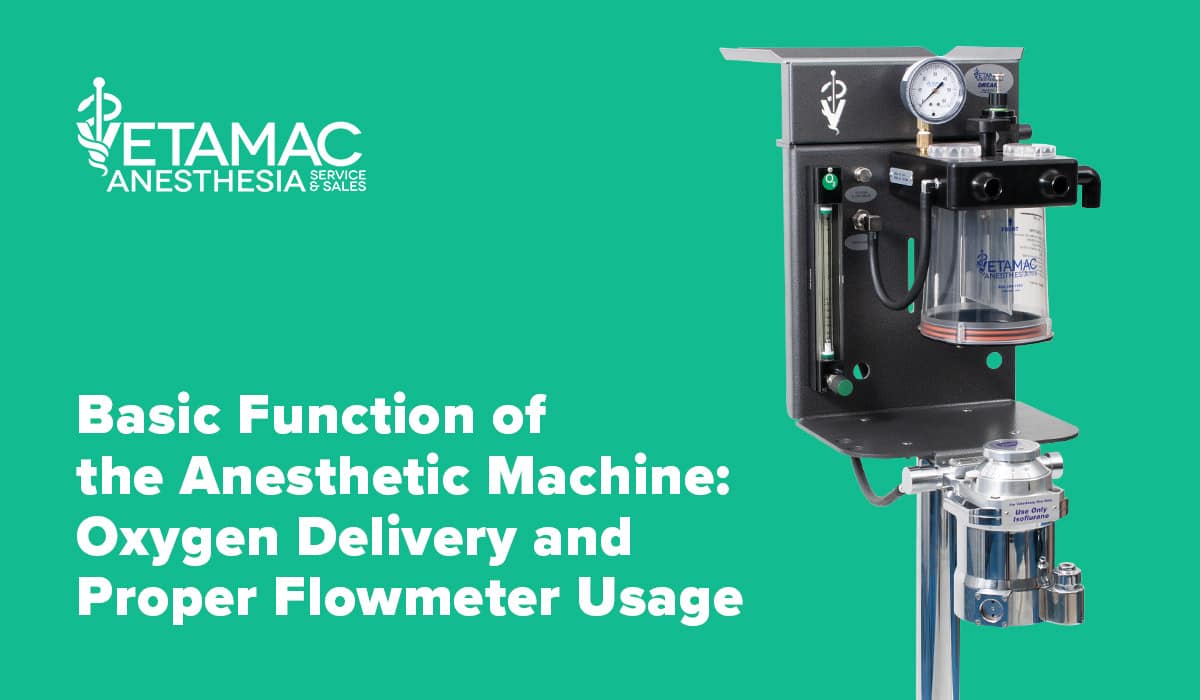
This newsletter will focus on the first basic function of an anesthetic machine which is to deliver oxygen.
Oxygen is most often provided as a compressed gas in cylinders that have a valve in the neck. Cylinders vary in capacity with the most common two being the small “E” cylinder, which usually attaches to the machine, and a much larger “H” cylinder, which is located remotely from the machine.
Oxygen cylinders are considered full when the tank pressure is 2000 pounds per square inch (psi). If a cylinder in use is at 1000 psi, it is 50% full; at 200 psi, it is 10% full. “E” cylinders contain 650 liters, and “H” tanks contain 6900 liters at 2000 psi.
The valves on O2 cylinders should be opened very slowly until the pressure on the regulator gauge stops rising. Then the valve can be opened completely. Under no circumstance should a wrench or pliers be used to open the valve.
A regulator with the proper fittings must be attached to the tank. The regulator should have two gauges:
The regulator reduces the pressure to a point that is safe for all components of the oxygen system. For most applications, this pressure is 40-50 psi.
Oxygen for the patient breathing circuit is delivered to the anesthetic machine either by the flowmeter or the flush valve.
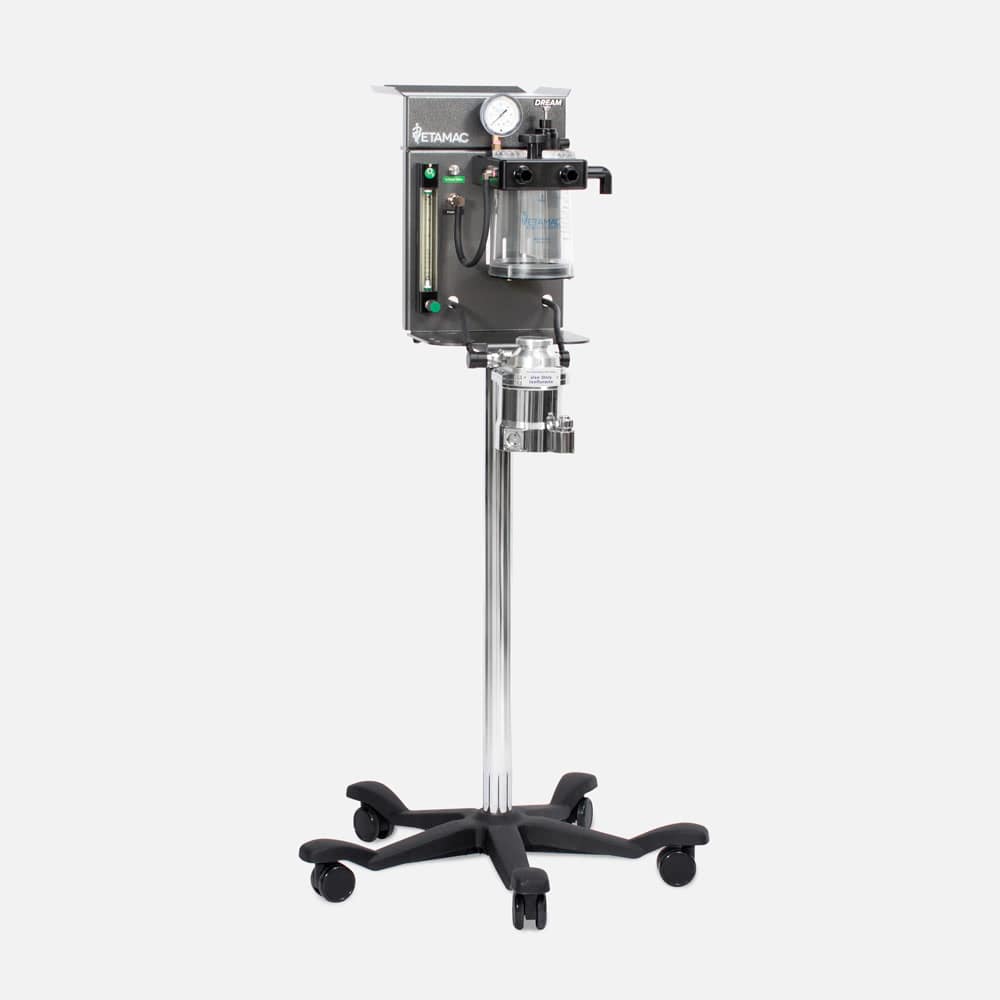
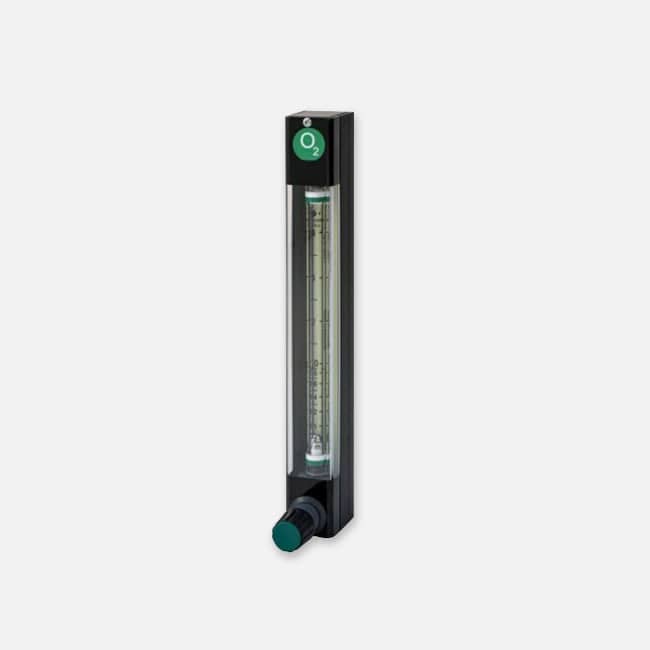
Flowmeters are operated with a knob attached to a needle valve. When the needle valve is opened, oxygen flows through a vertical tube that is labeled in milliliters or liters per minute. The flow of oxygen causes an indicator in the tube to rise, and the flow rate is read at the appropriate label.
The indicators have various shapes, but the most common is a ball. The flow rate is read at the point on the indicator where there is the greatest resistance to flow. If a ball is the indicator, this point would be the center of the ball.
When operating the flowmeter, the control knob should not be over-tightened. Doing so may result in damage or breakage to the needle valve. Always turn the flowmeter off when oxygen is no longer needed. If the flowmeter is on when the oxygen supply is turned on for the next procedure, the sudden pressure on the open flowmeter may cause the indicator to lodge at the top of the tube and possibly break the tube.
Caution should be exercised when the flush valve is used to deliver oxygen to the breathing circuit. Always operate the flush valve with the pop-off (APL) valve open. Stop the oxygen flush before the rebreathing bag is completely filled. Failure to do so will result in high pressure in the circuit, which in turn could cause damage to the patient’s airway.
The flush valve should also be used cautiously when using a non-rebreathing system because the oxygen is delivered directly to the patient connection on the system. It should be noted that some anesthetic machines have flush valves that are either restricted or do not have a high-volume flush. This increases the margin of safety when using these flush valves.
To assess the volume of oxygen being flushed, occlude the patient connection on the breathing tube, then operate the flush valve and observe how quickly the rebreathing bag fills.
At the end of the day, the oxygen supply should be shut off or the machine disconnected if a central oxygen system is in use. This will prevent needless oxygen consumption if a flowmeter is not off or if there are small leaks in any of the connections on the machine.
Following these guidelines to operate the machine will result in the safe and efficient use of oxygen.
The anesthetic machine must deliver vaporized anesthetic agent to the breathing circuit in concentrations that are optimal for the desired effect. Since the liquid agent is in a closed system, a carrier gas must be present to deliver the vaporized agent to the breathing circuit. The gas used to accomplish this is the fresh gas flow of oxygen.
The anesthetic machine must deliver vaporized anesthetic agent to the breathing circuit in concentrations that are optimal for the desired effect. Since the liquid agent is in a closed system, a carrier gas must be present to deliver the vaporized agent to the breathing circuit. The gas used to accomplish this is the fresh gas flow of oxygen.
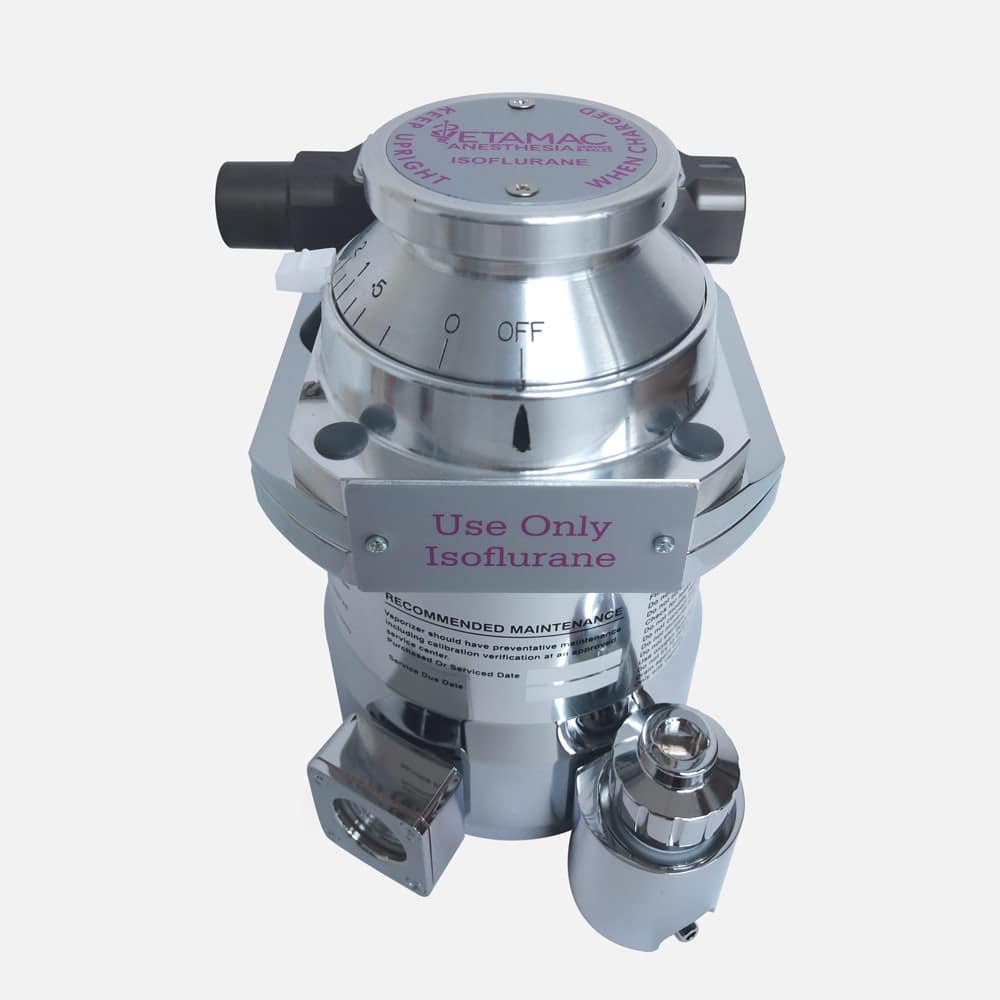
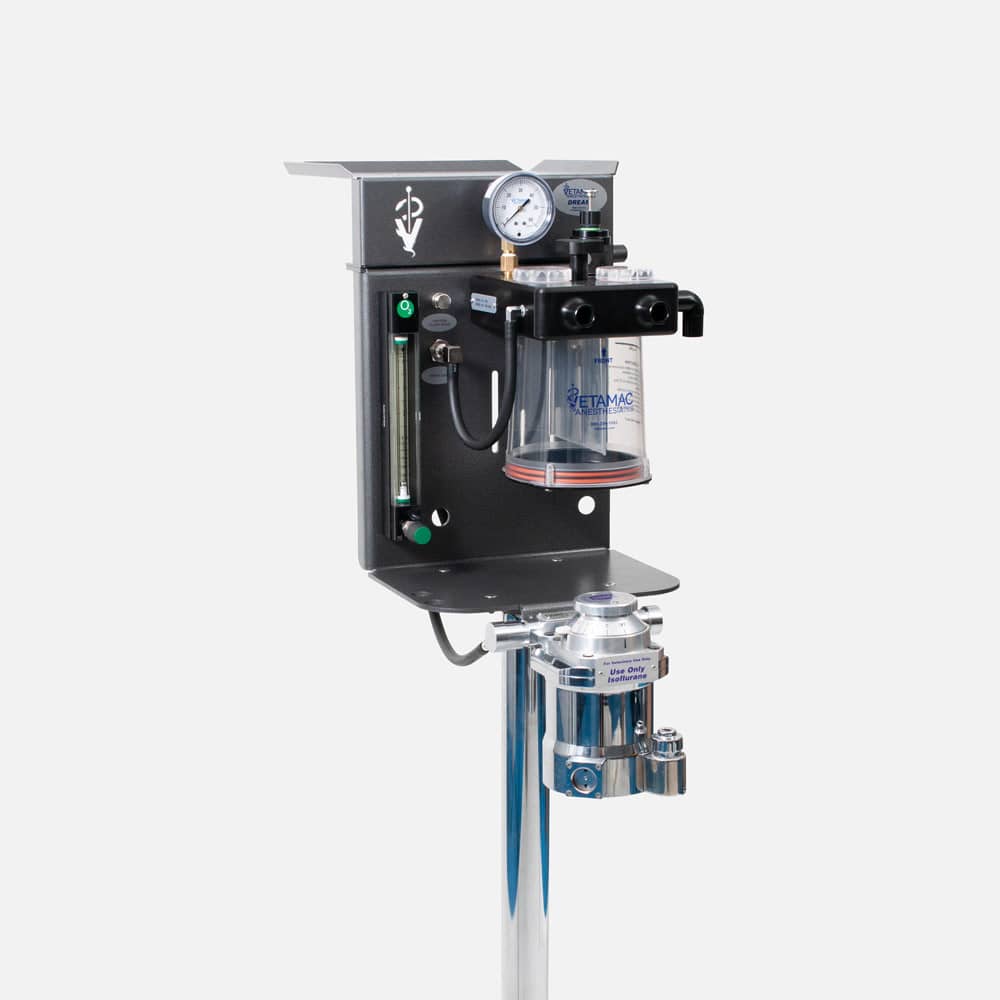
In almost all anesthesia machines used today, the liquid agent is contained in an agent-specific vaporizer that is outside the patient breathing circuit. The fresh gas flows from the flowmeter to the vaporizer. A very precise portion of the flow is diverted into a vaporization chamber where it is saturated with vaporized anesthetic. It is then mixed with that portion of the flow that bypassed the vaporization chamber and is delivered to the breathing circuit.
The anesthetic vaporizer also has a thermal compensation device. This is necessary because the liquid anesthetic cools as vaporization occurs and makes vaporization more difficult. This device then diverts more of the flow into the vaporization chamber to compensate for the cooling. Most vaporizers are constructed of brass, which conducts heat from the ambient air to the liquid to minimize the magnitude of the temperature change. This assures that the vaporizer output is constant despite changes in temperature.
Vaporizers have a dial with numbers from 0-5 for isoflurane and 0-8 for sevoflurane. These numbers represent volume percent and indicate the concentration in percent delivered to the output of the vaporizer.
If the fresh gas flow is 1 liter per minute and the dial is set at 2%, this means that 0.98 liters per minute of oxygen and 0.02 liters per minute of agent are leaving the vaporizer and are delivered to the breathing circuit. Doing the math, it is evident that if the fresh gas flow is 2 liters per minute, the amount of agent consumed will be doubled and vice versa. The same relationship is true in relation to the dial setting on the vaporizer.
It is important to remember that the numbers on the dial do not necessarily indicate the depth of anesthesia. That is determined by assessing the patient, not the vaporizer setting.
Some vaporizers are filled with liquid agent by using a pin fill device. There is an agent-specific spout that replaces the cap on the agent bottle. There is a keyed pin that fits into the fill manifold on the vaporizer. It is locked into place, and the vaporizer is filled to the desired level on the window.
Most vaporizers used in the U.S. have a funnel fill device, and the liquid agent is simply poured into the vaporizer. Care must be exercised to avoid spillage. Anti-Spill™ adapters are available that replace the cap on the agent bottle and minimize the potential for spillage. The window that indicates the level of liquid in the vaporizer will help prevent over-filling and will also indicate when the liquid level is low. Operating the vaporizer with the level too low may result in lower-than-indicated concentrations.
The fill cap on funnel-fill vaporizers has an O-ring that seals against the funnel surface. Each time the cap is removed, the O-ring and funnel surface should be wiped with a 4×4 gauze pad moistened with alcohol. This prevents the buildup of dirt particles that could cause a leak in the vaporizer.
All vaporizers have a drain plug to allow the vaporizer to be drained. This plug is usually in the center of the funnel fill device. Continuous removal of the cap to fill the vaporizer may cause the drain plug to become loose, resulting in agent leaking from the drain. The drain plug should periodically be checked to ensure that it is tight.
No vaporizer should be subjected to “blunt force trauma” as a result of moving the anesthetic machine or from other portable equipment being moved in the vicinity of the anesthetic machine. Not only can this result in external damage, but internal damage to the thermal compensating device may also occur.
The external surface of the vaporizer should be cleaned periodically using a 4×4 gauze pad moistened with alcohol. No liquid should be poured or sprayed on the vaporizer for the purpose of cleaning.
The calibration of the vaporizer should be checked periodically, and if necessary, the vaporizer should be serviced. Most vaporizers will provide many years of reliable service with proper care and maintenance.